
Counselling in Halifax – Professional Support for Anxiety, Relationships, Anger & More

Life can sometimes feel overwhelming, even when everything appears to be carrying on as normal. You might be holding things together for everyone else while quietly struggling yourself. Perhaps your relationship has become difficult, anxiety is leaving you constantly on edge, anger is affecting those around you, or you’ve simply reached a point where you’re exhausted from carrying everything alone.
Whatever has brought you here, you’re welcome.
I’m James Pearson, an Integrative Humanistic Counsellor and Psychotherapist, offering private counselling for adults across Halifax and Calderdale. I provide a calm, confidential space where you can talk openly without fear of judgement, pressure or being told what you “should” do.
Many of the people I work with arrive feeling stuck rather than broken. They’ve often spent months—or even years—trying to cope on their own before deciding it’s time to speak with someone outside of family, friends or colleagues.
Counselling isn’t about giving advice or finding quick fixes. It’s about understanding what’s happening beneath the surface, making sense of your experiences and helping you move towards lasting change at a pace that feels right for you.
Whether you’re looking for support with anxiety, relationship difficulties, depression, anger, stress, bereavement or simply feeling lost, counselling offers a space that’s entirely yours.
Handy Navigation for this page:
Why choose me for counselling in Halifax?
My approach to counselling
What many people notice during counselling
Feedback from Clients in Halifax…
What Can Counselling Help With?
Areas I Commonly Help With
What Counselling Can — and Can’t — Do
Who I Work With
Counselling for people living in and around Halifax
How Counselling May Help with Anxiety
Relationship Difficulties
Anger Often Has a Story
Depression Isn’t Always Sadness
Grief Doesn’t Follow a Timetable
Mental Health Support in Halifax
Why Choose Me for Counselling in Halifax?
What Happens During the First Session?
Frequently Asked Questions About Counselling In Halifax…
Further Reading
Taking the First Step
Counselling in Halifax
Interested in Private Counselling in Halifax?
Why Choose Counselling in Halifax?
Halifax is a town with a strong sense of community. Many of my clients live and work locally, while others travel from across Calderdale, including Sowerby Bridge, Elland, Hipperholme, Northowram, Shelf, Mytholmroyd and the surrounding villages.
Life here can be busy in ways that aren’t always obvious. Some people commute daily into Leeds or Bradford before returning home to family responsibilities. Others juggle demanding caring roles, long working hours or the pressures of running a business. From the outside everything may appear manageable, yet internally it can feel very different.
One thing I notice repeatedly is how many people believe they have to keep coping because “other people have it worse.” They minimise their own struggles, convince themselves they’ll feel better eventually or worry they’ll be wasting someone’s time.
The truth is that you don’t have to reach crisis point before seeking support.
Many clients tell me they wish they’d started counselling much earlier.
My approach to counselling
Every person who walks through my door has lived a completely different life.
That means no single counselling approach can ever fit everyone.
I’m an Integrative Humanistic Counsellor, which means I draw on established therapeutic approaches while always keeping our relationship at the heart of the work. Rather than following a rigid formula, I adapt therapy to the individual sitting in front of me.
Some people need space simply to be heard for perhaps the first time in years.
Others want to understand why they keep repeating certain relationship patterns.
Some arrive with overwhelming anxiety that never seems to switch off.
Others describe feeling emotionally numb, disconnected or unsure who they are anymore.
Wherever you’re starting from, we work together to understand what’s happening rather than simply trying to suppress symptoms.
I won’t analyse you or tell you how to live your life.
Instead, I’ll help you explore your thoughts, feelings and experiences in a way that allows genuine understanding and lasting personal growth to develop naturally.
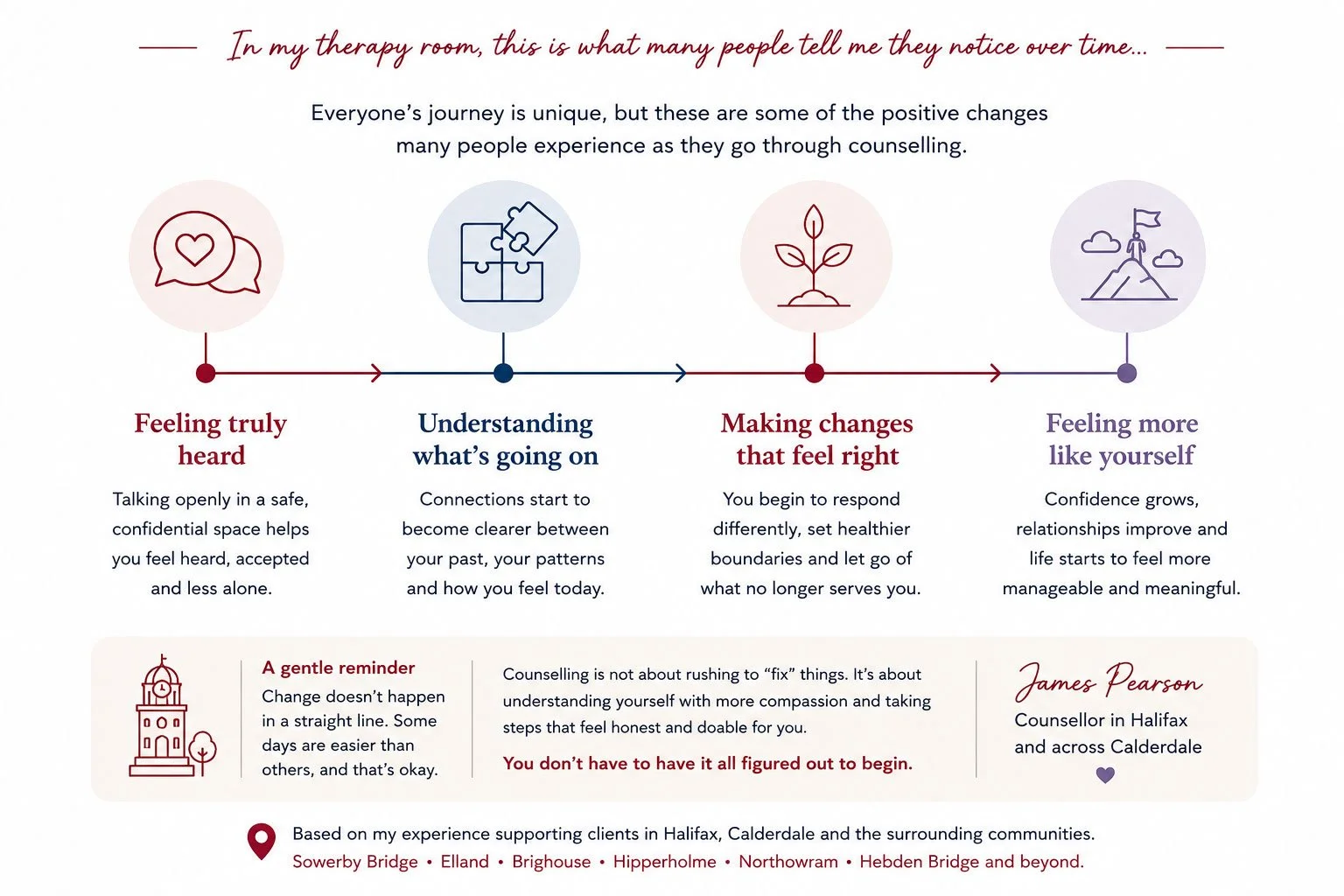
What many people notice during counselling
Feedback from Clients in Halifax…
“I decided I needed the help of a trained councillor to help me through a difficult period in my life. I was very uncertain, thinking it would be a very unpleasant experience and there would be long periods of silence and lots of tears.
James put me at ease immediately, I felt very comfortable and relaxed and was able to talk through all my problems
James was very astute and helped me work through the issues and come to a very sensible conclusion
I felt I was talking to a friend, but also someone who has had experience and training to really help
I would happily go to see James again, if I felt I needed to.”
— Anonymised Client“I just want to say that I am so grateful to you for all your help the past few months. I would not be where I am now without your support. I hope you are forever proud of the work you do and difference you make!”
— Anonymised Client“Thank you James for being such a punctual, focused and deeply observing person! Your dependability, your genuinely being interested in hearing your clients, your gentle, comforting smile and affirming that what you hear is what I meant is incredible! These are characteristic traits becoming less and less visible in today's world and the authenticity in your interaction with me was tangible!! I really look forward to every time we talk! You definitely have found your passion and your talents are real!! Warmest regards ~ till our next conversation. Thank you for being you!!”
— Anonymised ClientWhat Can Counselling Help With?
People often contact me believing they need to have a clear explanation for why they’re struggling.
In reality, many don’t.
Sometimes they simply know that life feels harder than it used to.
Counselling can help with many different challenges, including:
* Persistent anxiety or constant worrying
* Anger that feels difficult to control
* Stress and burnout
* Low self-esteem
* Feeling emotionally overwhelmed
* Life transitions and uncertainty
* Family difficulties
* Workplace pressures
* Feeling disconnected from yourself or others
These experiences often overlap.
For example, ongoing anxiety can place strain on relationships. Relationship difficulties can contribute to depression. Long-term stress may leave someone feeling emotionally numb or increasingly irritable.
Rather than treating each issue in isolation, counselling allows us to understand the wider picture and how different parts of your life influence one another.
If you’re unsure whether counselling is right for your situation, that’s completely understandable. Many people arrive with uncertainty, and exploring that uncertainty is often where therapy begins.

From my therapy room…
“I don’t even know where to start.”
People sometimes apologise because they feel their thoughts are all over the place or because they think they’re talking about the wrong thing.
There isn’t a wrong place to begin.
In my experience, meaningful counselling rarely starts with a perfectly organised account of someone’s life. More often, it begins with whatever feels most present in that moment. As trust develops, people naturally start connecting experiences, emotions and patterns they hadn’t previously recognised.
Some of the most significant breakthroughs I’ve witnessed haven’t come from asking the perfect question—they’ve come from creating enough safety for someone to hear themselves differently.
That process can’t be rushed, and it doesn’t need to be.
Areas I Commonly Help With
Although every person’s experience is unique, there are certain challenges I work with regularly.
Anxiety Counselling
Living with anxiety can feel exhausting. Constant worrying, overthinking, physical tension and always expecting something to go wrong can make everyday life feel much harder than it needs to.
If anxiety has become part of your daily life, you may find my dedicated page on Anxiety Counselling helpful, where I explain more about how therapy can support you.
Relationship Counselling for Individuals
Relationships can be one of the greatest sources of happiness—and one of life’s greatest emotional challenges.
You may be struggling with communication, repeated conflict, trust issues, separation, emotional distance or simply questioning whether your relationship can continue.
Although I work with individuals rather than couples, individual counselling can provide valuable space to understand relationship dynamics, explore your own needs and decide how you want to move forward.
You can also explore my dedicated Relationship Counselling page and supporting articles covering communication difficulties, walking on eggshells and recognising when a relationship may no longer be healthy.
Anger Counselling
Anger is often misunderstood.
Behind anger there may be hurt, fear, frustration, disappointment or years of feeling unheard.
Counselling isn’t about teaching you never to feel angry. It’s about understanding what your anger is trying to communicate and finding healthier ways of responding.
My Anger Counselling page explores this in much greater depth.
Depression and Low Mood
Depression doesn’t always look like constant sadness.
For many people it’s emotional exhaustion, numbness, lack of motivation or simply feeling disconnected from life.
If that sounds familiar, my Depression Counselling page and related articles explore these experiences in more detail and explain how counselling may help.
Grief and Bereavement Counselling
Grief is one of the most personal experiences we can go through.
While it’s often associated with the death of someone close, grief can also follow the end of a relationship, the loss of health, a major life change, redundancy or letting go of the future you had imagined.
There is no “right” way to grieve.
Some people experience overwhelming sadness, while others feel anger, guilt, relief, numbness or a confusing mixture of emotions that seem to change from one day to the next. Many worry that they should be coping better or that they ought to have moved on by now.
In counselling, there’s no expectation that you should grieve according to a timetable. Instead, therapy offers a compassionate, confidential space to explore your loss, make sense of your emotions and gradually find a way to carry what has happened while continuing to move forward with your life.
If you’re living with bereavement or another significant loss, my dedicated Grief Counselling page explains more about how counselling can support you through the grieving process.
What Counselling Can — and Can’t — Do
People often arrive hoping counselling will take away painful feelings.
While therapy can certainly reduce distress over time, that’s not really its purpose.
Life will always include uncertainty, disappointment, grief, conflict and change. Counselling isn’t about pretending those experiences don’t exist or trying to replace difficult emotions with positive thinking.
Instead, it’s about changing your relationship with those experiences.
As we begin to understand where your thoughts, emotions and patterns come from, they often become less overwhelming. Many people find they become more self-aware, more confident in setting boundaries, more accepting of themselves and better equipped to respond differently when life becomes challenging.
Counselling also isn’t about being given advice.
Although people sometimes ask me, “What would you do?”, my role isn’t to tell you how to live your life. Lasting change usually comes when you discover your own answers rather than following somebody else’s.
Therapy provides a space where those answers can emerge naturally.
Who I Work With
I offer counselling for adults aged 18 and over from Halifax and across Calderdale.
Some people contact me after a recent life event has left them feeling overwhelmed. Others have lived with anxiety, low mood or relationship difficulties for many years before deciding they’re ready to explore things more deeply.
Many of the people I work with describe experiences such as:
* Constant overthinking that never seems to switch off.
* Feeling responsible for everyone else’s happiness.
* Losing confidence in themselves.
* Repeating the same relationship patterns.
* Feeling emotionally exhausted despite appearing to cope.
* Becoming increasingly irritable or angry.
* Feeling disconnected from who they used to be.
* Struggling with grief that hasn’t eased with time.
* Wondering why they feel unhappy despite life looking “fine” on paper.
Whatever your situation, counselling begins with understanding your experience rather than trying to fit you into a label or diagnosis.

From my therapy room…
“One thing that continually stands out is how often people apologise”
They apologise for crying.
They apologise for talking too much.
They apologise for not knowing what they feel.
Sometimes they even apologise for coming to counselling in the first place.
What I usually notice is something very different.
I see someone who’s spent a long time trying to manage everything on their own and has become used to putting other people’s needs before their own.
One of the simplest but most powerful parts of therapy is discovering that you don’t have to earn the right to be listened to.
Counselling for people living in and around Halifax
Although my practice is based nearby, I regularly work with people from right across the Halifax area and the wider Calderdale district.
Clients often travel from places including:
* Halifax town centre
* Elland
* Hipperholme
* Northowram
* Shelf
* King Cross
* Boothtown
* Illingworth
* Mytholmroyd
* Ripponden
* Hebden Bridge
* Brighouse
Each area has its own character, but many of the concerns people bring into counselling are remarkably similar.
Busy family lives.
Work pressures.
Relationship difficulties.
Anxiety that seems to have gradually become part of everyday life.
The feeling that they’re constantly looking after everyone else while neglecting themselves.
Counselling offers an opportunity to pause, reflect and begin understanding what’s really happening beneath the surface.
How Counselling May Help with Anxiety
Anxiety isn’t always obvious.
For some people it’s racing thoughts.
For others it’s constant physical tension, poor sleep, irritability or never quite feeling able to relax.
Many people tell me they spend hours imagining worst-case scenarios or replaying conversations long after they’ve happened.
Over time this can become exhausting.
Rather than simply trying to stop anxious thoughts, counselling helps us become curious about them.
Why do they appear?
When did they begin?
What purpose might they be serving?
Understanding anxiety often reduces its power.
If anxiety is something you’re experiencing regularly, you may also find my dedicated Anxiety Counselling page helpful, along with articles exploring overthinking, emotional exhaustion and understanding anxious patterns.
Relationship Difficulties
Relationships influence almost every part of our emotional wellbeing.
Whether you’re questioning the future of a relationship, struggling with communication, living with constant conflict or finding yourself walking on eggshells, these experiences can leave you feeling isolated and emotionally drained.
Many people assume relationship counselling only involves attending together as a couple.
In reality, individual counselling can be equally valuable.
Working individually allows you to understand your own emotional responses, attachment patterns, boundaries and communication style before deciding how you want to move forward.
Many clients tell me they begin therapy wanting to understand another person but leave with a much clearer understanding of themselves.
If relationships are your main concern, you’ll also find further guidance on my dedicated Relationship Counselling page together with articles exploring communication difficulties, emotional safety and recognising unhealthy relationship patterns.
Anger Often Has a Story
Very few people describe themselves simply as “an angry person.”
Instead they say things like:
“I’ve just got a really short fuse.”
“I don’t know why I react like that.”
“I bottle everything up until I explode.”
“I hate the person I become.”
In my experience, anger is often the visible part of something much deeper.
It may protect feelings of hurt, shame, fear, rejection or helplessness.
Sometimes it develops after years of feeling ignored.
Sometimes it reflects stress that’s gradually become impossible to contain.
Counselling isn’t about removing anger.
It’s about understanding it.
When people begin recognising what sits underneath those reactions, they often discover healthier ways of responding without losing themselves in the process. You can read more on my dedicated counselling for anger page.
Depression Isn’t Always Sadness
One of the biggest misconceptions about depression is that it always looks like crying.
Often it doesn’t.
People describe feeling emotionally flat.
Disconnected.
Unable to enjoy things they once loved.
Going through the motions each day without really feeling present.
Others continue working, caring for their families and meeting responsibilities while privately wondering why everything feels so difficult.
Depression can affect motivation, confidence, concentration, relationships and physical energy.
Therapy provides space to explore those experiences without judgement while gradually helping you reconnect with yourself in meaningful ways. You can learn more on my dedicated depression counselling page.
Grief Doesn’t Follow a Timetable
Whether you’ve lost a loved one, experienced the end of a relationship, lost your health, your career or the future you imagined, grief rarely follows predictable stages.
Many people worry they’re grieving “incorrectly.”
There isn’t a correct way.
Some people cry frequently.
Others barely cry at all.
Some feel intense sadness.
Others feel anger, guilt, numbness or relief.
All of these experiences can be part of grief.
Counselling doesn’t ask you to move on.
Instead, it helps you find a way of carrying your loss while continuing to live a meaningful life. Learn more about counselling for grief on my dedicated page.
Mental Health Support in Halifax
Counselling can be one important part of looking after your mental wellbeing, but it’s not the only source of support available.
If you’re looking for local services, crisis support, NHS resources or community organisations across Halifax and Calderdale, I’ve created a dedicated Mental Health Resources in Halifax guide bringing together trusted organisations in one place.
Whether you’re seeking immediate help, supporting a family member or simply exploring what’s available locally, it’s designed to make finding reliable support a little easier.
Why Choose Me for Counselling in Halifax?
Choosing a counsellor is a personal decision.
Qualifications and professional memberships matter, but so does finding someone you feel comfortable talking to. Research consistently shows that the quality of the therapeutic relationship is one of the strongest predictors of successful counselling.
My aim is to provide a space where you can speak honestly, feel genuinely heard and explore whatever has brought you to counselling without fear of judgement.
I am an Integrative Humanistic Counsellor and Psychotherapist with a Distinction in Integrative Counselling & Psychotherapy. I am an Accredited Member of the National Counselling and Psychotherapy Society (NCPS) and a Registered Member of the British Association for Counselling and Psychotherapy (BACP).
My practice is grounded in current ethical standards, regular professional supervision and ongoing professional development. That means you can be confident that your counselling is delivered within recognised professional frameworks while remaining centred on you as an individual.
Every client brings a different story, which is why I avoid one-size-fits-all approaches. Together, we’ll work at a pace that feels safe and appropriate for you.
What Happens During the First Session?
Starting counselling can feel like a big step, especially if you’ve never spoken with a therapist before.
Many people worry they’ll be expected to share everything immediately.
That isn’t how I work.
The first session is an opportunity for us to begin getting to know one another. We’ll talk about what’s brought you to counselling, what you’re hoping might change and any questions or concerns you have about the process.
There’s no pressure to discuss anything before you’re ready.
Some people arrive knowing exactly what they want to explore.
Others simply know that life doesn’t feel how they’d like it to.
Both are completely okay.
By the end of the session, we’ll usually have a clearer understanding of your current situation and whether we feel we’re the right fit to work together.

From my therapy room…
“I didn’t realise how much I needed to talk.”
One of the nicest moments often comes towards the end of a first session.
It’s not uncommon for someone to pause before leaving and say something like:
“I didn’t realise how much I needed to talk.”
Nothing in their circumstances has changed in that hour.
The challenges are still there.
But many people notice that simply being able to speak openly, without interruption or judgement, feels surprisingly different.
Counselling isn’t about having all the answers after one session.
It’s about beginning a process that allows those answers to develop over time.
Frequently Asked Questions About Counselling In Halifax…
-
Not at all.
Many people begin counselling because they recognise that something doesn’t feel right, even if they can’t quite explain why. Seeking support early can often prevent difficulties from becoming more overwhelming.
-
There isn’t a fixed number.
Some people benefit from working through a specific issue over a relatively short period, while others prefer longer-term therapy to explore deeper patterns and experiences.
We’ll regularly review how things are progressing and make decisions together.
-
Confidentiality is a fundamental part of counselling.
I’ll explain how confidentiality works during our first session, including the limited circumstances where I may have an ethical or legal responsibility to share information, such as where there is a serious risk of harm.
-
Many people find counselling helpful because it provides the time and space to understand what’s happening rather than simply trying to manage the symptoms.
Whether you’re struggling with anxiety, relationship difficulties, anger, depression or grief, therapy can help you develop greater understanding, healthier ways of coping and increased confidence in moving forward.
-
Yes.
Alongside in-person sessions, I also offer secure online counselling for clients who find this more convenient or prefer to attend from home.
-
No.
I work with individual adults aged 18 and over.
However, individual counselling can be extremely valuable for exploring relationship difficulties, communication patterns and understanding your own needs within relationships.
Further Reading
If you’d like to explore specific topics before arranging a session, you may find these pages helpful:
* Mental Health Resources in Halifax
These guides explain some of the issues I commonly help with and answer many of the questions people have before beginning therapy.
Taking the First Step
Reaching out to a counsellor can feel daunting.
For many people, sending that first message is the hardest part of the whole process.
Whether you’ve been thinking about counselling for months or only started looking today, there’s no expectation that you need to have everything worked out before getting in touch.
You don’t need the right words.
You don’t need a perfect explanation.
You simply need somewhere to begin.
If you decide to contact me, we’ll arrange an initial appointment where we can explore what’s brought you to counselling, discuss any questions you may have and consider whether we’re the right fit to work together.
There’s no pressure and no obligation beyond that first conversation.

Counselling in Halifax
Life isn’t always straightforward, and none of us are meant to carry everything alone.
Whether you’re living with anxiety that’s becoming exhausting, relationship difficulties that feel impossible to untangle, anger that no longer feels under control, depression that’s left you feeling disconnected, or grief that continues to weigh heavily, counselling offers a place to slow down, reflect and begin making sense of what you’re experiencing.
I welcome clients from across Halifax, Sowerby Bridge, Elland, Brighouse, Hebden Bridge, Hipperholme, Northowram, Shelf and the wider Calderdale area, providing a calm, confidential and professional space where you can talk openly at your own pace.
If you’re ready to take that first step, I’d be pleased to hear from you.
Together, we can begin exploring what has brought you here and work towards helping you move forward with greater understanding, confidence and hope.

Interested in Private Counselling in Halifax?

Let's Talk…
James Pearson
Accredited Counsellor
Inside Soul Wellness Hub,
Burnley Road
Sowerby Bridge,
Halifax,
HX6 2TL
Call / Text me:
07783772108
Email Me:
james@whatiscounselling.com